First Day of Class [online and face-to-face versions]
[ready for Fall 2026]
Modified: 2026-07-16
10:34 AM CDST
-
Welcome to General Psychology! Here is some information to help you
do well this semester. Some of you will be in a face-to-face class. Others will take it online. The material is the same for both versions..
Who is your instructor?
- Edward P. Kardas is Distinguished Professor of psychology and has been at SAU since 1980! (That means I'm old!)
- He is married (since 1988) to the former Julie McCuller of
Texarkana and they have three children: two males (born 1990 and 1992) and one female (born 1997).
- Somehow, all three ended up working as engineers. They live in Little Rock, Buffalo, NY, and Columbus, OH, respectively.
- Hobbies: Swimming, target shooting, reading, and taking care of my dog Icy.
- Good news! We are now grandparents
- Our first grandchild, John Edward Kardas, was born on December 16, 2021. Our second grandchild, Thomas Anthony Kardas was born, on January 4, 2024.
| John Edward Kardas 2021 |
Thomas Anthony Kardas 2024 |
 |
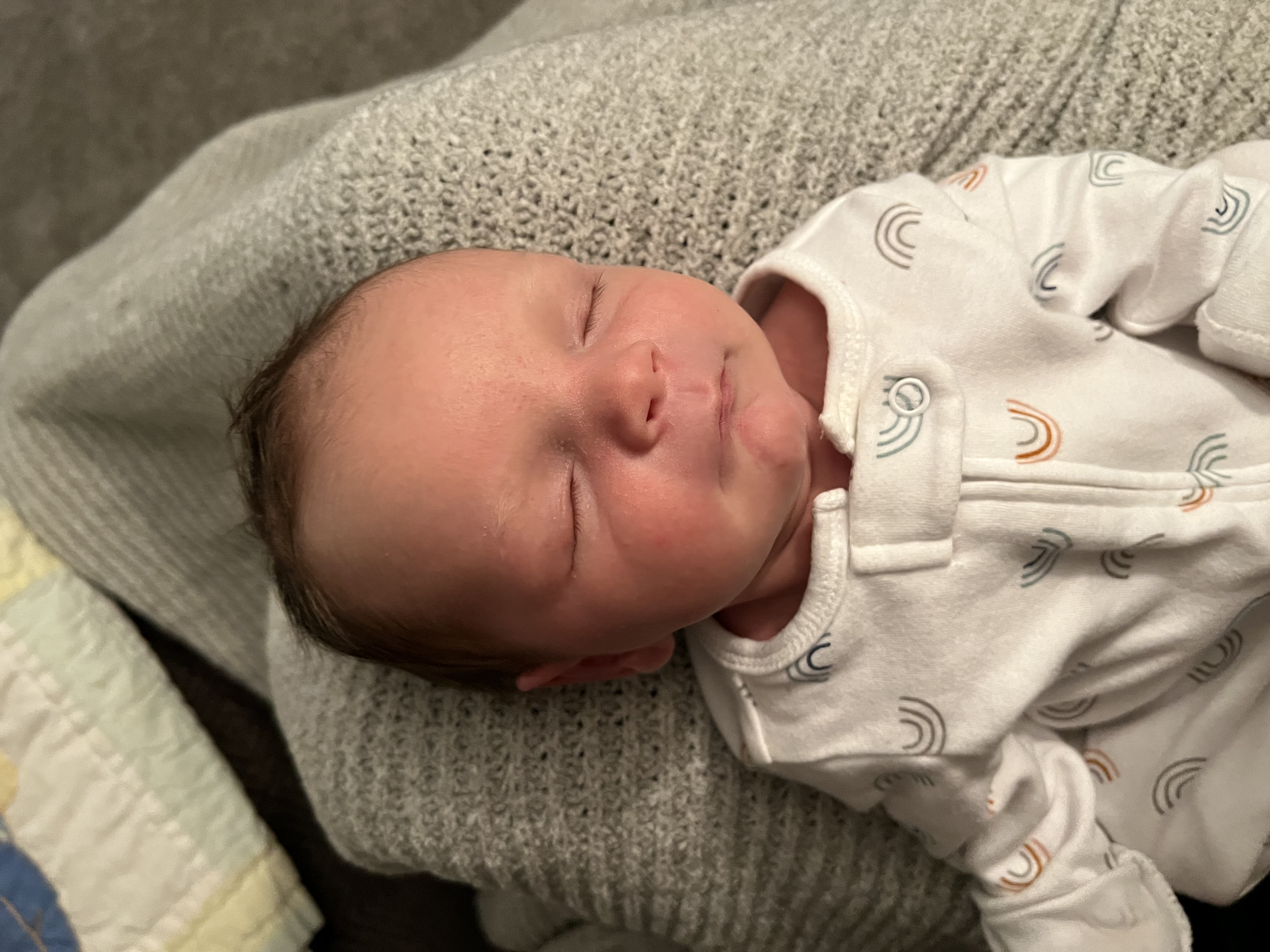 |
- What is general psychology?
- General Psychology (GP) is perhaps one of the hardest courses in the
department because it attempts to cover so much material in a short
period of time.
- Later courses in psychology are much more focused
than GP so they are not as shallow.
- The department subscribes to an accretion strategy (for majors, that is); that means we teach the same concepts over and over
- Hopefully, most of that content will stick by graduation time
- Most graduate schools in psychology, BTW, do the same thing.
In other words, after they accept students they assume they know little about psychology, so they continue the accretion strategy
- Graduate schools do one more important thing, they make their students teach. Having to teach something is a surefire way to learn.
- As stated previously, the course begins with a look at:
- the history of psychology, the
research methods psychologists use, and the biological bases of
psychology.
- then the areas of sensation and perception are examined
as are variations in consciousness.
- learning and memory are covered
next.
- personality, psychopathology, and therapy close out the course.
- Understand that the list above by no means covers all of psychology,
much must be left out. You should feel free to read and enjoy the
chapters we do not cover in class
- (Did you catch the accretion method at work here? Two pages contain the same information.)
- What happens in class?
In face-to-face classes:
- Mostly, I talk and you listen and take notes.
- However, that process
does not have to be dull and a lot of work.
- I will show you short
movies, conduct brief demonstrations, and set-up opportunities for
class participation.
- I expect you to have and ask questions
often.
- AND
- Notetaking and notetaking skills are also needed in class.
- I don't want to see anyone just sitting at a desk without some notetaking method be it analog (paper and pen) or electronic (laptop or pad).
- However, nearly everything I say in class is available on the Web
page.
- You should download and print those class notes and organize
them in a three-ring binder.
- See below for instructions on how to
download the lectures and other materials.
- My new online advice:
- What used to be my class lectures are now outlined on the web page. Here is some of the information from chapter 12 as an example:
- The "Big Five" theory of personality looks at:
- Conscientiousness
- Agreeableness
- Neuroticism
- Openness
- Extraversion
- Taken together, these traits are very useful in describing personality
- Mnemonics to remember them are CANOE or OCEAN
- If you are curious and want to see the whole set of lectures for chapter 12, click HERE
- You will find out that many psychologists believe that those five traits describe a great portion of personality
- If you want to take a short test on (10-item) these five traits, e-mail me
- Naturally, there's a textbook. You should get one and read it. More on that below.
- I'll also make the textbook's PowerPoints available to you as well.
- They are on Blackboard, our learning management system, I'll have video and audio materials for you to hear and look at there.
- What materials do I need?
- You will need the textbook for sure. This is not one of those classes
where you can get away with not buying the text.
- You will also need to download the notes. CLICK HERE They are labelled as chapter-specific LECTURES. Click on them as needed.
- What about tests and grading?
- Tests are a combination of objective items (multiple choice and true or false).
- Grading Your grade is based on your total points (250
possible). That's five tests of 50 points each.
- I'll make the tests available on a schedule. See our main page for those dates.
- You will take the tests online when you wish.
- Your grades will be available on Blackboard.
- Your individual test grades thus accumulate.
- The more tests you take the more solid your grade is.
- To eliminate cheating, all tests will be open book and open notes.
- But, that means the tests themselves will be a learning experience. Hopefully, as you try to find the information and then answer the questions you'll be learning the material better than you would have by taking a test the old way.
- Grading will be tougher because of the test format and the open book, open notes. So, if you want an A you will need to average 92% correct answers or 188 out of 200 points for the four tests that count.
- I will drop your lowest test at the end of the course.
- Please take all five tests.
- REMEMBER, you will have time to take each test and you will be able to stop and come back to the test as needed. In this class, your job is to FIND the answers and record them on the BlackBoard tests.
- What about attendance?
- Full attendance is expected in the face-to-face section.
- Roll will be taken daily because of new federal law. (I will use Quickly)
- Past experience has demonstrated a strong positive
correlation between class attendance and higherfinal grades.
- In the online section:
- This is online education and you must keep up with the class yourself.
- The old routines are no more.
- You need not show up in class now!
- For BOTH sections:
- I have set the class up so that it is self-paced.
- That means that you can decide how fast or how slow you want to go.
- You must complete Test 1 before the four-week grades are due. (No later than Friday, September 19, 2026)
- You must complete all five tests by the last day of the final exams.
What about extra credit?
There is no extra credit, so do well on your tests!
Back to Main Psychology Page