- Daniel Kahneman
- Nobel Prize Biography (fascinating reading, fyi)
- Amos Tversky
- Prospect Theory
- Defining a Decision Under Risk
- Nik Wallenda on Grand Canyon Gorge (video)
- Risk: Uncertainty about gain or loss from a choice
- Blaise Pascal and Risk Assessment
- Pascal and Fermat's Correspondence
- Expected Utility
- From 1950s on, Expected Utility Theory was dominant theory in the analysis of decision making under risk
- Nik Wallenda on Grand Canyon Gorge (video)
- What is Prospect Theory
- Prospect Theory was a challenge to Expected Utility Theory
- Started with 14 problems designed to show flaws in Expected Utility Theory
- Gains
- Problem 1
A: (4,000, .8) or B: (3000, 1.0)
N = 95 [.20] -----------[80]*
Certainty effect: In other words, take the sure thing.
- Problem 2
C: (4,000), .20) or D: (3,000), .25)
N= 95 [65]* ------------[35]
Problem 2 is a restatement of Problem 1 but probabilities are divided by 4
Option C has a relatively larger reward - Losses
- Problem 3
A: (-4,000, .80) or B: (-3,000, 1.0)
N=95 [92]*---------------[8]
- Problem 4
C: (-4,000, .20) or D: ((-3,000, .25)
N=95 [42]----------------[56]
Sure gain in Problem 2 is replaced by risky loss of 4,000
Reflection Effect: Risk aversion in for gains, risk seeking for lossesProblem 5 You have been given 1,000
A: (1,000), .50 or B: (500, .1.0)
N=70 [16]---------------[84]*
Problem 6 You have been given 2,000
C: (-1000, .50) or D: (-500, .1.0)
N=68 [69]*--------------[31]
Replicates Reflection Effect
But Final States of Wealth are identical (p. 206)
In Prospect Theory people perceive gains and losses to a neutral reference point
Utilities and probabilities undergo systematic cognitive distortions.
There are two phases in Prospect Theory: Editing and Evaluation
In editing, the following operations were proposed: coding, combination, segregation, cancellation)
The editing function was criticized as being not well-specified or parsimonious.Evaluation phase was better developed. In contrast to Expected Utility Theory it added a value function and a weighting function
People evaluate gains and losses relative to a neutral reference point
People tend to be risk averse to gains and risk-seeking to losses
The above lead to value function of Prospect Theory (video)Graph of Prospect Theory
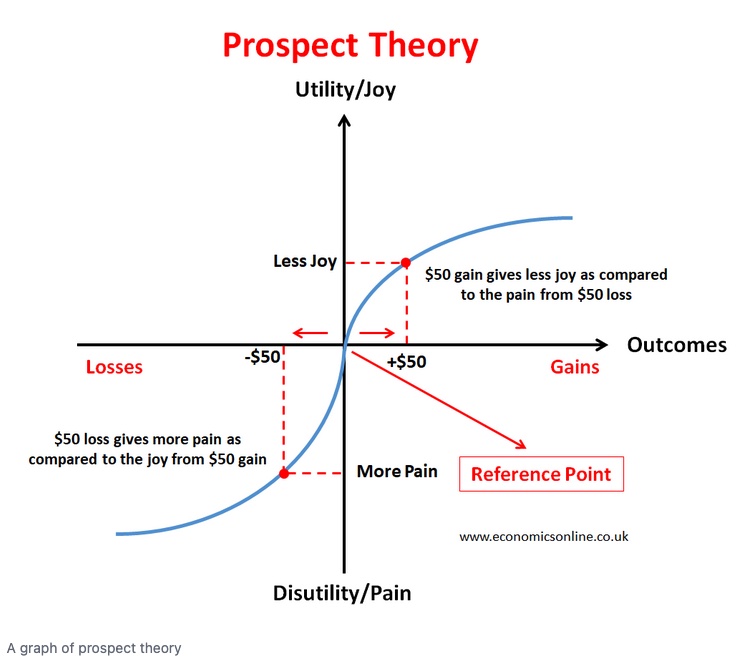
From: https://www.economicsonline.co.uk/definitions/prospect-theory.html/
Problem 7
A: (5,000, .001) or B: (5, 1.0)
N=72 [72]*-----------[28]a
Here, people weigh large gain more than its expected value.
This is akin to buying lottery ticketProblem 8
C: (-5,000, .001) or D: (-5, 1.0)
N=72 [17]-----------[83]*
Here, people prefer the sure loss rather than risk a large on.
This is similar to buying insurance.- So, Prospect Theory:
- Keeps the assumptions of Expected Utility Theory
- But maximizes expectations, not objective utilities
- Table 14.1 (p. 209) shows the Fourfold Pattern of choice behavior
- Prospect Theory was a challenge to Expected Utility Theory
- Kahneman's Nobel Prize
- Highly cited and noticed by economists and psychologists
- Real World Examples
- Racetrack bettors (punters in Great Britain, fyi) and poker players attempt to cover their losses
- Golfers putt better on par putts than on birdie putts
- Gave rise to Behavioral Economics
- Editing phase still problematic
- Refererence points set to 0 may not work when problems have multiple options
- In other words, context matters
- Adding emotions (regret and rejoicing) following choice behavior does not add much to Prospect Theory
- More Issues:
- Description-Experience Gap
- Rare Events
- Sample Size
- Prospects for Prospect Theory:
- Alter the Weighting Function across paragigms
- Analyzing the role of experience, sampling, memory, and learning
- Looking at fundamental issues:
- Sampling and Ambiguity
- Effect of longer time horizons
- Role of dynamic environments
- Relationship of probability and choice behavior
Problem 9
A: one chance in a million to win $1 million
B. 90% chance to win $12 and 10% chance to win nothing
C: 90% chance to win $1 million and 10% chance to win nothings
Option C would hurt more, revealing that reference point of 0 does not apply to all probabilities
Problem 10
A: ($200, .04; $150, .21; $100, .50; $50, .21; $0, .04)
B: ($200, .20; $150, .20; $100, .20; $50, .20; $0, .20)
Here, there are multiple, ranked ways to win leading to cumulative probabilities (e.g., winning something)
- Prospect Theory is viable alternative to Expected Utility Theory
- Framing is important
- Mathematics and Psychology are not equivalent
- More examination of loss aversion
- Are there simpler models for human dccision making?
- Discussed how economists really believed that humans made rational choices most of the time.
- Wrote about Richard Thaler
- Nobel Prize in Economics 2017
- "How do human traits govern individual economic decisions and what effect do they have on markets as a whole? Since the 1980s, Richard Thaler has analyzed economic decision-making with the aid of insights from psychology. He has paid special attention to three psychological factors: the tendency to not behave completely rationally, notions of fairness and reasonableness, and lack of self-control. His findings have had a profound influence on many areas of economic research and policy.
- Nobel Prize in Economics 2017