Memory I
Modified: 2026-03-07 6:36 AM CST
Working memory is the topic covered in chapter 8. Episodic and semantic memory are covered in chapter 9.
Chapter 8 Memory: Beyond Baddeley and Hitch's (1974) Working Memory--Robert H. Logie
- Background to the Classic Study
- Alan Baddeley
- Graham Hitch
- Working Memory
- Working memory, according to Baddeley and Hitch, should help explain its importance to:
- everyday tasks
- language
- logical reasoning
- Diagram
- Short-Term Memory (Atkinson and Shiffrin)
- Sensory Register
- Short Term Memory
- Long Term Memory
- Diagram
- Detailed Description of the Classic Study
- Problems with Atkinson and Shiffrin Model
- Patient KF
- Had very severe short-term memory
- Could only remember one or two random numbers from a list of six
- Healthy adults average five remembered numbers
- But, he could:
- Understand language
- Carry on a conversation
- Retrieve information from long-term memor
- Remember more random numbers if he read them
- His specific problem was auditory-verbal short-term memory
- All of the above were problems for the Atkinson-Shiffrin model
- Findings (pp. 102-108)
- Short-term memory for aural material could be damaged independently visual
- Location of working memory (see Figure 8.1B)
- Working memory is a separate set of systems outside of long-term memory
- Preload to six items affected reasoning task and memory for preload differently
- Rehearsal was important (articulatory suppression)
- Similarly sounding words more difficult to repeat (phonological similarity effect)
- The longer the time necessary to say words made those words more difficult to repeat back (word length effect)
- Phonological store plus rehearsal became the articulatory loop and later the phonological loop
- The above shows how Baddeley and Hitch developed their model of working memory
- Impact of the Classic Study
- The visuo-spatial sketch pad
- Developed later
- Memory for visual mental images disrupted by irrelevant pictures but not by irrelevant spoken words (Logie, 1986)
- It remembers: movement sequences, images, appearances,
- It is separate from phonological store (See Figure 8..3)
- Later work
- Mostly conducted in Great Britain and Italy
- Children adept at repeating nonsense word sequences also had better language skills
- Might be important in learning new vocabulary
- Brain damage data
- Patient IV had difficulty in learning new vocabulary
- Alzheimer's patients had difficulty performing two tasks simultaneously and binding shapes and colors
- Episodic Buffer?
- Critique of the Classic Study
- 1974 article often cited incorrectly (later research more telling than the original)
- But, more citations of late than previously
- Central executive is problematic
- Homunculus and infinite regress
- Control is provided otherwise via: inhibition, updating, and task switching
- Maybe control comes from local interactions similar to:
- ant colonies, movements of non-human primates, bird flocking, or even the internet of things
- Sentence span and operation span tests
- Both rely on individual differences and are popular in North American psychology
- But they may miss other cognitive abilities (text call them "blunt instruments" p. 112)
- Notice the orchestra vs specific instrument analogy (p. 113)
- Other Theories
- Cowan
- Invokes attention into working memory
- Oberauer
- Interference not decay
- Long standing problem not yet resolved
- Working Memory is now used inconsistently in the literature
- Conclusions
- Baddeley's toothbrush example re his theory: everyone has a toothbrush but they only want to use their own
- Thus, many variations of working memory exist
- Adversarial collaboration (pp. 115-6)
- Result apply to:
- children's language development
- counting and mental arithmetic
- reasoning and problem solving
- dividing and switching attention
- navigating
- aging and brain impairments
- individual differences
- tracking of daily life
- Logie believes Baddeley and Hitch's theory has scientif value and influence
- Afterthought: Comment from Alan Baddeley
- Both he and Hitch decided to study STM
- They focused on the function of STM
- Gordon Bower's invitation was fortunate
Chapter 9 Memory: Beyond Tulving's (1972) Episodic and Semantic Memory--Michael W. Eysenck and David Groome
- Background to the Classic Study
- Endel Tulving
- Episodic Memory
- Do you remember crossing the Delaware Memorial Bridge in 1954 when a bee flew in the back window, landed on your thigh (you were wearing shorts), and stung you?
- Of course you don't. That is MY episodic memory.
- Fyi, I was wearing shorts. The bee lingered briefly before stinging me. Our Chevrolet did not have airconditioning and my window was open. I was sitting behind my mother and my father was driving. At that point, I was an only child. The car was painted black. We were going West on the bridge. The sting hurt.
- But, you will have your own collection of episodic memories.
- Metaphors
- Memories in specific locations
- Aviary (Plato)
- Switchboards
- Tape recorders
- Conveyor belts
- Hard drives
- Notice the above do not account for the types of LTM
- Atkinson and Shiffrin used such single store LTM models
- Tulving added episodic and semantic LTMs
- Episodic memory:
- Tulving's Assumptions:
- Perceptual events stored in episodic memory
- Episodic memories are different from semantic memories
- Retrieval changes episodic memories but not semantic ones
- Episodic are vulnerable to change and interference
- Detailed Description of the Classic Study
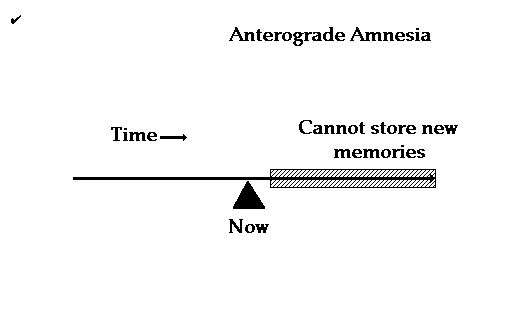
- Anterograde amnesia
- Notice the brief period of STM below
- Severe anterograde amnesia may lead to hospitalization (danger to others)
- Retrograde amnesia
- Retrograde amnesia can vary widely in terms of time and specific memory loss
- If you can't remember your name, you have severe retrograde amnesia
- Alcoholic blackouts are examples of partial memory loss

- Impact of the Classic Study
- Early studies of brain damage and memory often confounded episodic and semantic memories
- Patient HM, for instance, was eventually found to possess episodic and semantic memory loss
- Patient HC showed loss of episodic memory but no loss of semantic memories
- Patient Jon showed episodic amnesia
- Thus, episodic memory and semantic memory can be separately impaired leading to the conclusion that each is governed separately by the brain
- Multiple trace theory
- Brain creates new episodic traces continually
- Eventually, those traces may create a semantic memory
- For example, seeing many dogs may create a semantic memory for the concept of dog
- More memory types (Schacter & Tulving, 1994))
- Episodic
- Autobiographical
- Time-tagged
- Semantic
- "Knowledge"
- Example, What is capital of France? or What is capital of Burkina Faso?
- Hopefully, you know Paris. You likely did not know Ouagadougou.

- Perceptual Representational
- Procedural
- Example, most likely if you once learned to ride a bicycle you can still do so acceptably
- Consciousness
- Episodic has higher degree of consciousness than does semantic
- Episodic has property of mental time travel
- Brain and Memory

- Critique of the Classic Study
- Tulving identified his shortcomings
- Semanticisation
- Episodic memories become semantic over time
- Example, 3 x 7 = 21 (semantic), but at one time it was episodic (when you first learned it)
- Episodic and semantic share similarities
- He did not identify, at first, other forms of memory (procedural)
- His views on semantic memory were too narrow
- Renoult et al. (2016)--Four categories
- Unique events
- General factual knowledge
- Autobiographical facts
- Repeated personal events
- Question types 3 and 4 required retrieval from episodic and semantic memory
- Tulving (again)
- His earlier assertion of no difference between episodic and autobiographical memories was wrong
- Episodic memories can have a future orientation
- Andrews-Hanna, Saxe, and Yarkoni (2014)
- Autobiographical retrieval is more extensive (brainwise) than episodic
- Wu and Barsalou (2012)
- Context in sematic memory is important
- Responses to lawn and rolled up lawn were different
- Hub-and-Spoke Model
- Concepts include:
- Unchanging central core of meaning
- Plus variable information
- Thus, Tulving's approach to semantic memory was too limited
- Both episodic and semantic are likely involved in everyday tasks
- Cabeza, Stanley, and Moskovich (2018, Abstract)
- "A PSA is a small team of brain regions that rapidly assemble to mediate a cognitive process in response to task demands but quickly disassemble when the process is no longer needed."
- Conclusions
- Tulving (1972):
- Major importance
- Led way to broader view of memory
- More complex than originally assumed
- Memory processes are not independent
Back to Main Advanced Cognitive Psychology

