Cognitive Psychology: Revolution or Evolution?
Modified: 2025-12-22 1:30 PM CST
Was there a revolution in psychology or not? I argue against a revolutionary interpretation of the re-emergence of cognitive psychology. Recall the thumbnail description of psychology's history: Psychology finds mind, psychology loses mind, psychology finds mind again. This course will trace the major breakthroughs in cognitive psychology and link those to modern cognitive psychology.
The course starts with an overview drawn from chapter 14 of my history of psychology text. See how to download that chapter in the Canvas page for this course.
This page is only an outline of the chapter. You should read the entire chapter as well.
Zeitgeist: How it is to live in a particular time and place and to experience its particular culture, morals, and intellectual surroundings. We are living in a 21st Century, post COVID, American time and place. Think of some of the features of both. Now, imagine the zeitgeist of your parents and grandparents. How did those evolve into the present? Imagine future American zeitgeists; do you think AI will be a part of those?
ZEITGEIST: World War II
- Brief history of early World War II
- Expansionist agendas of Germany and Japan
- Germany annexes Austria and Czechoslovakia's Sudetenland
- Japan invades China
- War begins
- Germany and Russia invade Poland
- War continues
- Germany invades Belgium and France
- Britain evacuates troops from Dunkirk
- Aerial battle of Britain
- Prewar USA
- Antiwar sentiment
- Lend-Lease for Britain
- Pearl Harbor and Beyond
- Japanese attack Pearl Harbor on December 7, 1941
- American public opinion radically shifts toward revenge
- Hitler declares war on USA
- Allies decide on Europe first Pacific second strategy
- Psychology's Wartime Role
- Selection methods for soldiers, sailors, and airmen
- Dealing with "shell shock" (now called PTSD)
- Those methods among the first "seeds" of modern cognitive psychology
- Digital Computers
- Newly developed devices useful in cryptanalysis and problem solving (another seed)
- Memory and Language
- Prewar research on both was fundamental (another seed)
- Neurophysiology
- Prewar research linking the brain and cognition in humans and animals (another seed)
- Postwar
- The seeds grew into a new and different account of cognition; one that did NOT depend on introspective accounts or a non-physical mind
PREVIEW
- The following terms became well-defined and commonplace after World War II
- digital computers
- codebreaking
- software
- hardware
- information
- memory
- problem solving
- information processing model
- algorithms
- heuristics
- language studies
- neurophysiology
- animal cognition
- All of these will be covered in this chapter
THE SLOW MOVE TO COGNITIVISM
- Introspective psychology's failure
- Behaviorism and Neobehariorism's partial dominance
- New topics:
- sensory registers
- types of memory
- heuristics
- Shared methodology by nearly all psychologists (experimentation)
- data collection and analysis
- Differing interpretations of data
- Behaviorists: S-R theory
- Cognitivists: Cognitive processes derived from digital computing (e.g., input, output, and storage)
- New Questions (Thanks to cognitive psychology)
- Is the brain a computer?
- How does memory affect behavior?
- How do people (and animals) solve problems?
- What is language? How is it accquired?
- What are the neurophysiological underpinnings of cognition?
- Can human cognition be created or exceeded via technology?
- The five doors to modern cognitive psychology
- the computer model
- memory
- problem solving
- language
- neurophysiology
COMPUTERS AND PSYCHOLOGY
- Early Computers
- Atanasoff-Berry Computer (ABC) at Iowa State University
- Colossus
- used to break enemy codes (German Enigma machine)
- US Navy
- broke Japanese diplomatic code and later naval code JN-25
- helped secure US victory at Battle of Midway
- Postwar Use of Computers
- New concrete metaphor for cognition
- software (programs or thoughts and plans) How many apps are on your smartphone?
- hardware (analogous to brain) How many electronic devices do you own?
- FYI, when I was a freshman I went to college with a typewriter and a record player
- Beginnings of AI
- New Model for Human and Animal Thinking
- Differences between human and animals: brain size and complexity of software
- von Frisch's honeybees could 'compute' flower types along with the distance and direction to those
- AI emerged early too (Newell and Simon, see below)
- Psychology
- Absorbs Cognitive Science
- Re-absorbs philosophy, linguistics, anthropology, and neuroscience
- Diverges from computer science
MEMORY
- Ancient Topic in philosophy
- Emerges in psychology via Ebbinghaus (but not Wundt)
- Bartlett's Research (not covered in your textbook)
- Interested in errors made, meaning, and natural contexts
- "War of the Ghosts" story
- readers retold the story using terms familiar to themselves
- Led to the modern terms of surface structure and deep structure
- His naturalistic approach was revived by Neisser in the 1970s
- Bartlett one of the first to define a schema:a dynamic cognitive unit based on previous knowledge that reconstructs memories and new knowledge.
VERBAL LEARNING
- Methods Designed to Study Human Learning and Memory (and Forgetting)
- Paired Associates
- Serial Methods
- Primacy
- Recency
- Forgetting
- Decay Theories
- Interference Theories
- proactive interference
- retroactive interference
- Memory Organization Theories
- Chunking
- Limits to short-term memory (Miller, 1956)
- Information Processing
- Debt to computer model
- Electronic revolution (Mainframes->Personal Computers->Tablets->Smartphones->Smartwatches->????)
- Atkinson-Shiffrin Model
- Sensory Registers
- Visual (iconic)
- Auditory (echoic)
- Short-Term Memory
- 30 seconds or less without rehearsal
- Long-Term Memory
- Unlimited Capacity
- Potential to last a lifetime
- Modifications:
- Levels of processing (Craik and Lockhart, 1972)
- Episodic and Semantic Memories (Tulving, 1972)
- Working Memory (Baddeley and Hitch, 1974)
- FYI, all of the above are usually covered in nearly any textbook for general psychology
PROBLEM SOLVING
- Mental Set or Einstellung:
- a temporary readiness to perform certain psychological functions that influences the response to a situation or stimulus, such as the tendency to apply a previously successful technique in solving a new problem. It is often determined by instructions but need not be. Essentially synonymous with the older term Einstellung, mental set is the embodiment of the earlier concepts of Aufgabe and determining tendency. (APA Dictionary of Psychology)
- Luchins Water Jars (see page 175 in your textbook for brief comment on Luchins)
- Luchins primed participants to solve similar problems using the same method or algorithm.
- Later, participants mostly missed finding a simpler solution
- He inferred that they failed to perceive the simpler solution
- Insight Learning: a type of learning in which a solution to a problem appears suddenly, usually after a period of time has passed (an impasse) since the problem was first presented.
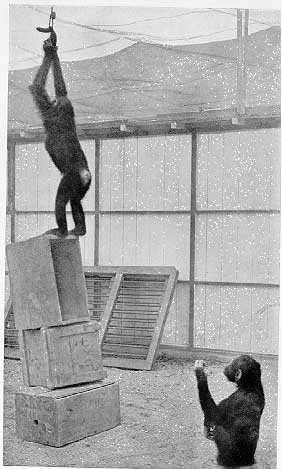
- Köhler and his chimpanzees on Tenerife
- The chimpanzees suddenly moved the boxes necessary for them to reach the banana overhead: Image of chimpanzee Grande solving the problem
- Modern research (Ash, Lee, and Wiley, 2012)
- Undergraduates solved puzzles and mathematical problems after being coached on thinking aloud while solving the problems
- Some problems led to impasses.
- They inferred that "this emphasis on internal representation is what motivated the resurgence of interest in cognitive psychology..." (p. 22)
REPRESENTATIONS
- Representation: a remnant of a previous experience that allows that experience to affect later behavior (Roitblatt, 1982, p. 353). He goes on to state that representations have five parts:
- Domain
- Specific Content
- Code
- Medium
- Dynamism
- This class's domain is psychology. It's specific content is cognitive psychology. It's code is English. It's medium is electronic communication and all of its part are subject to change.
- Example:
- What should I do on " oh and two?" That question is unanswerable without understanding its representation.
- The domain is baseball (or softball).
- The specific content is pitching and batting
- The code are the rules of baseball (and softball)
- The medium is English (in this instance, but it could be in any language)
- Many aspects of the representation are subject to change. For example, the addition of a designated hitter who does not field. Or, the ability to play games at night under lights. (Try playing golf at night :-)
- See the chapter for further discussion on this example. Note that the batter and the pitcher have different goals and behaviors.
- See the examples in the chapter.
- How tall was the person who robbed the convenience store?
- What kind of cat did I just see in the alley?
- How would you represent this cat?

- She (most likely) is a calico
- Very few calicos are males
- Cat coat colors (in case you want really want to know more :-)
- Other examples (from the chapter) of representations:
- Codes
- Languages (including slang)
- I believe this will be a crunk course
- Occur in all perceptual modalities
- Old milk stinks (olfactory)
- Icons convey information (visual)
- Been to Starbucks lately? Seen this icon?
- Media
- Gravestones (etched granite)
- Paper and ink
- VCR tapes (magnetic spots)
- Your computer screen
- Blackboard and chalk
- Dynamism
- Beowulf in Old English:
- Swa begnornodon Geata leode
hlafordes hryre, heorðgeneatas,
cwædon þæt he wære wyruldcyninga
manna mildust ond monðwærust,
leodum liðost ond lofgeornost.
- In modern English:
- So the Geatish people, companions of his hearth, mourned the fall of their lord; said that he was mighty king, the mildest and kindest of men, most gracious to his people, and most desirous of praise.
- Can you understand ANY of the Old English?
- Slang is dynamic too (Is this a crunk course?)
- Culture is also dynamic (Same gender marriage)
- Origins of Representation in Cognitive Psychology
- Computer Programming
- arithmetical (early on)
- linguistic
- graphical
- logical
LOGIC THEORIST
- Newell and Simon (1956) created a computer program, Logic Theorist, that successfully created proofs for 38 of the 52 theorems in Whitehead and Russell's Principia Mathematica (1910).
- Their work was one of the earliest attempts to create Artificial Intelligence (AI)
- Logic Theorist used heuristics, subgoaling, and learning
- Today's explosion of Large Language Models (LLMs) such as ChatGPT and other similar programs is an example of the AI branch first elucidated by Newell and Simon
- The other branch, the psychological one, introduced now familiar terms such as: heuristics, problem spaces, and operators
- Newell and Simon's "trick problems" or problems that can be solved "without any search whatsoever."
- Examples:
- How are these numbers arranged?
8, 5, 4, 9, 1, 7, 6, 3, 2, 0
- Unfortunately, the answer is not mathematical. Let's re-represent them:
Eight, Five, Four, Nine, One, Seven, Six, Three, Two, Zero
- Have you switched your problem space?
- Is there a mathematical solution?
- Otro ejemplo para ustedes
5 4 2 9 8 6 7 3 1 0
Cinco, Cuatro, Dos, Nueve, Ocho, Seis, Siete, Tres, Uno, Zero
Comprendido?
- So if some 6,000 languages exist, I should be able to generate many similar examples? N'est ce pas?
Heuristics and Problems Solving
- Newell and Simon used four heuristics in Logic Theorist: substitution, detachment, chaining forward, and chaining backward
- Heuristics are similar to "rules of thumb", are based on experience, and DO NOT (unlike algorithms) guarantee a solution
- Problem Space includes:
- Present State
- Goal State
- Necessary Operators
- analogy
- induction
- metacognitive process
- Problem solving heuristics include:
- means-ends
- subgoaling
- working backwards
- analogies
- Examples:
- Means-Ends
- I need to travel from Texarkana to Dallas
- Using the means-ends heuristic I should just move 180.4 miles SW until I hit Dallas
- If you imagine you are on the mythical Sea of Texas you only need a compass heading
- FYI, the example in the chapter is similar but uses the route from Magnolia, AR to Little Rock
- Subgoaling
- More realistically, getting to Dallas will require:
- roads
- a vehicle
- fuel
- knowledge
- context
- Each of the above is a separate problem to solve
- For instance, not having a vehicle will make the solution difficult or impossible
- Working Backwards
- This heuristic is very useful
- If the goal is to be in Dallas by 5 pm, then several steps must follow:
- Driving time
- Fueling
- Personal Issues:
- meals, grooming, responsibilities
- The time required for each must be computed and then scheduled in a backwards fashion
- Analogy
- Here, only driving driving on an Interstate will be analyzed. Understand that other factors will also prevail
- Successful use of analogy in driving will include much previous learning:
- stay on the right side of the road (in USA, but not in Great Britain or Japan)
- what traffic light signals mean
- what the speed limit is
- not riding the bumper of the vehicle in front of you
- knowing how to properly use an Interstate highway
- Direct Auto Insurance lists the following things to keep in mind about Interstate driving:
- merging
- using right lane most of the time
- keeping a safe following distance
- maintaining attention and vigilance
- avoiding distractions
- expecting the unexpected
- Could a person drive to Dallas from Texarkana without having learned about Interstates?
BIASED JUDGMENTS
- Tversky and Kahneman (1974) described how people often used heuristics that led to biased judgments.
- Here are three such heuristics:
- Representativeness
- One of their tests was the sentence: “Steve is very shy and withdrawn, invariably helpful, but with little interest in people, or in the world of reality. A meek and tidy soul, he has a need for order and structure, and a passion for detail.”
- Respondents were much more likely to peg Steve as a librarian and not as a farmer, salesman, airline pilot, or physician.
- In other words, respondents bring their own biases into play. Farmers, salesmen, airline pilots, or physicians, too, could fit the description in the sentence above.
- In 1979, at a carwash in Milwaukee, in a Honda Accord with Louisiana plates (53 K 134) with a toolbox visible in the rear, dressed in workboots and a flannel shirt, one of the attendants asked if I was a construction worker.
- Imagine his surprise when I revealed I was a college professor.
- Availability
- Here, participants judge probabilities of events based on factors such as: salience, concreteness, or imaginability
- Examples include:
- Doctors and nurses judge that their towns are sicker than they really are
- Police judge that their towns are more crime riddled than the are
- People judge that sharks kill more people than do bees
- Notice how the availability heuristic biases judgment in all of these cases
- Adjustment and Anchoring
8 x 7 x 6 x5 x 4 x 3 x2 x 1
vs
1 x 2 x3 x 4 x 5 x 6 x 7 x 8
- The answer is 40,320, but respondents averaged 2,250 for the first set and only 512 for the second set
- The initially higher numbers are the anchor for the first estimate while the initially lower numbers are the anchor for the second estimate
- Another example:
- First impressions are a good example of adjustment and anchoring
- Why wear business clothes to job interview?
- Because the employer's first encounter will set an anchor
- In my case, I nearly always dress casually (often shorts and Hawaiian shirts).
- So, when I interviewed for an internal deanship (unsuccessfully). I did not put on a business suit. For one thing, the committee would have laughed knowing I never wore such outfits.
- But,, would I have worn a business suit for an external ,position as dean? Yes, of course.
- Notice the difference in these two cases. The anchor was well set in my home campus but not in the other campus.
- FYI, Kahneman received the Nobel Prize for Economic Science in 2002
- Amos Tversky was no longer alive in 2002. Nobel Prizes are only awarded to the living. Otherwise, he would have received the honor as well.
LANGUAGE
- The study of language has a long history
- Plato and Aristotle wrote of rhetoric
- Humanities emerged in the Renaissance with the study of philology and modern linguistics
- Philology: The study of texts with the goal of determining authorship, priority, authenticity, and relationship to other texts. The term originally meant love of learning. Today, the term, linguistics, has largely replaced it.
- Linguistics: the scientific study of the physical, structural, functional, psychological, and social characteristics of human language. See also psycholinguistics; sociolinguistics. (APA Dictionary of Psychology)
Origins of Language
- Origins are an unsolved mystery
- Donald (2020) argued that language required two preconditions:
- The refinement of a wide variety of skills via practice and rehearsal
- The creation of stone tools along with being able to communicate how those were made
- He defined "mimesis" as:
- "...an embodied, analogue, and primordial mode of representation, in the sense that it is a preadaptation for language and also a self-sufficient cognitive adaptation in its own right, which accounts for some of the major features of human cultural and cognitive life. A mimetic act is a performance that reflects the perceived event structure of the world, and is the purest form of embodied representation. It has three behavioral manifestations that include rehearsal of skill, in which the actor imagines and reproduces previous performances with a view to improving them. Others include re-enactive mime, in which patterns of action, usually of others, are reproduced in the context of play or fantasy, and lastly, non-linguistic gesture, where an action communicates an intention through resemblance. The contents of mimetic acts are observable by others, which makes them a potential basis for a culturally accepted “mimetic” vernacular, enabling members of a group to share knowledge, feelings, customs, skills, and goals, and to create group displays of emotions and intentions that are conventional and deliberate. These types of shared representations seem quite limited, when compared to language, but constitute a powerful means of creating culture and sharing custom, feeling, and intent." (Donald, 2012, Abstract)
- FOXP2 Gene
- Mutated version of gene found in modern humans and Neanderthals
- FOXP2 gene is part of a complex of factor underpinning the biology of language
- Language in Psychology
- Chomsky's Syntactic Structures (1957)
- He argued that grammar (syntax) is primary and that morphology and phonology were secondary
- Chomsky's approach was in opposition to Skinner's
Language Acquisition
- Kuhl (2000) provided six tenets of language acquisition:
- So--
- • infants’ initially parse the basic units of speech allowing them to acquire higher-order units created by their combinations;
• the developmental process is not a selectionist one in which innately specified options are selected on the basis of experience;
• rather, a perceptual learning process, unrelated to Skinnerian learning, commences with exposure to language, during which infants detect patterns, exploit statistical properties, and are perceptually altered by that experience;
• vocal imitation links speech perception and production early, and auditory, visual, and motor information are coregistered for speech categories;
• adults addressing infants unconsciously alter their speech to match infants’ learning strategies, and this is instrumental in supporting infants’ initial mapping of speech; and
• the critical period for language is influenced not only by time, but by the neural commitment that results from experience.
- Details--
- Infants, thus, are sophisticated learners of language who are already learning language in utero.
- Moreover, that learning reshapes the brain and warps the brain’s perceptual processes.
- Animals share some aspects of these features of learning (categorical learning), but not others (the perceptual magnet effect)
- The alteration of the brain by language learning helps explain why second language learning in adults is difficult for them but not for children.
- (FYI, I learned English and Spanish as a child. I learned French as a teenager. My Spanish is much better than my French)
- Adults who learn a second language must depend on separate brain regions for those languages while children who learn two languages early in life do not (Kim, Relkin, Lee, & Hirsh, 1997).
- The study of language acquisition continues to be a complex and fertile area for cognitive psychology.
NEUROPSYCHOLOGY AND COGNITION
- Linking physiology and behavior is a long and ongoing goal for psychology
- Aristotle's body and soul (anima in Latin works for both English words "body" and "soul")
- Descartes's separation of mind and body was intentional and related to his dualistic theory
- The discoveries of details of the nervous system in the 19th Century (neurons, synapses) restimulated those efforts
- Lasheley's search for the engram and Hebb's conception of the cell assembly were early examples of neuropsychology
- Sperry's work on the "split-brain" and Kandel's on Aplysia each won Nobel Prizes
- But, science is still far away (my estimate is 300 years, fyi) from solid knowledge about the human nervous system and how it governs behavior
- Roger Sperry Nobel Prize
- Sperry and Gazzaniga severed the corpus callosums of volunteer epileptic patients
- Their medical goal was to end their grand mal seizures
- Instead, they discovered that severing the corpus callosums led to interesting phenomena
- One example was that was that patients could ONLY name objects flashed on a screen that went to their right visual field
- That information could not cross over from their left brains to their right brains because of the lesion of the corpus callosum
- Gazzaniga's (2014, p.18094) description was:
A circle is flashed to the right of fixation, allowing his left brain to see it. His right hand rises from the table and points to where the circle has been on the screen. We do this for a number of trials where the flashed circle appears on one side of the screen or the other. It doesn’t matter. When the circle is to the right of fixation, the right hand, controlled by the left hemisphere, points to it. When the circle is to the left of fixation, it is the left hand, controlled by the right hemisphere, that points to it. One hand or the other will point to the correct place on the screen. That means that each hemisphere does see a circle when it is in the opposite visual field, and each, separate from the other, could guide the arm/hand it controlled, to make a response. Only the left hemisphere, however, can talk about it. I can barely contain myself. Oh, the sweetness of discovery.
- Stimulation to the left eye (and, thus to the right brain) of blindfolded patients revealed they could not identify objects (e.g., combs) in left hands but could use them properly
- Eric Kandel Nobel Prize
- Mapped neural networks for habituation, sensitization, and dishabituation in the sea slug, Aplysia californica
- His and other research on animals with relatively few neurons has revealed:
- the hippocampus contains a cognitive map
- how short-term memory becomes long-term memory
- the relationship between synaptic strength and memory formation
- the relationship between depression and memory storage
Artificial Intelligence
- Artificial Neural Networks or Artificial General Intelligence
- Can we create a device that matches or exceeds human intelligence?
- Such intelligence would include:
- reasoning
- problem solving
- decision making
- common sense
- planning
- learning
- language
- imagination
In other words, pretty much of human cognition
- Plus, the above are only the cognitive aspects.
- Others add human physical traits as necessary components (e.g., locomotion, sensation and perception, ability to move objects, and hazard detection)
- Hesinger (2021) pointed out how academic disciplines differed on how they approached the problem of information
- Neurophysiology and Neural Engineering have already succeded in creating devices such as cochlear implants and cardiac pacemakers thanks to advaces in materials, miniaturization, computerization, and wireless communication
- Me, I'm waiting for the breakthrough in smart glasses
Animal Cognition
- Bräuer et al. (2020) believe the field of animal cognition has:
- been too anthropomorphic
- unwilling to accept examples of superiority of animal cognition
- ignored many sensory modalities (especially olfaction)
- not accounted for ecological contexts
- Animal cognition has re-emerged from Romanes's anthropomorphic approach and its near banishment by classical behaviorism
Main Advanced Cognitve Psychology Page